Biogenic Reefs – A Living Defense For Tangier Island
Biogenic oyster reefs offer elements an unprotected shoreline lacks: they are living structures providing a barrier capable of growing and adapting over time. Oyster larvae attach to existing shells and other hard surfaces. As generations of oysters grow on top of one another, the reef becomes larger, higher, rougher, and more complex. This three-dimensional structure disrupts incoming waves, reduces wave energy, encourages sediment to settle behind the reef, and can help protect marshes and shorelines from erosion. NOAA recognizes oyster reefs as a nature-based tool that, when properly located, can reduce wave energy, prevent erosion, and strengthen wetlands as protective barriers.
Perhaps most important for Tangier Island is the reef’s ability to grow vertically as sea level rises. In a landmark 2014 study published in Nature Climate Change, University of North Carolina researchers measured intertidal oyster-reef growth and found rates as high as approximately 11 centimeters—or more than four inches—per year under favorable conditions. The researchers concluded that oyster reefs have the potential to accrete rapidly enough to outpace projected rates of sea-level rise while submerged, eventually adjusting their growth as they reach their preferred intertidal elevation.
That makes an oyster reef fundamentally different from a seawall or static breakwater. Instead of simply deteriorating with time, a successful biogenic reef can continually add new oysters and shell, potentially increasing its protective capacity.
This concept is already being applied on a major scale through New York’s Billion Oyster Project, which is working to restore one billion oysters to New York Harbor. The organization specifically identifies shoreline protection among the benefits of restored reefs, including softening large waves, reducing flooding, and preventing erosion.
For Tangier Island, marine scientists Russ Burke, Dave Schulte, and Romuald Lipcius became heavily engaged in large-scale native oyster restoration in the Chesapeake Bay in the early 2000s, and were soon joined by Rochelle Seitz, with her focus on living shorelines and expertise on secondary production. Collectively, they have evaluated nearly every type of shell (oyster, clam, whelk, etc.) and alternative substrate (granite, limestone, recycled and/or crushed concrete, and pre-fabricated concrete structures with or without an oyster shell veneer) oyster reef in Virginia waters, including on the Bayside and Seaside Eastern Shore, for oyster and mussel production, as well as for secondary production. In particular, Russ Burke has been investigating the viability of shell-embossed concrete structures for oyster and fish reefs, as well as for wave attenuators – we call these reefs “Biogenic Breakwaters.”
Three types of Biogenic Breakwater Reefs will be deployed along the shore to Protect Tangier Island.
X-Reefs
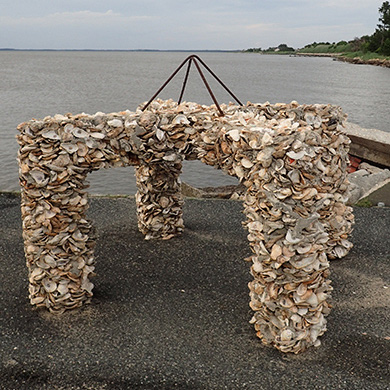
X-Reefs are innovative, nature-based structures designed to reduce wave energy, protect vulnerable shorelines, and create productive marine habitat. Their open, three-dimensional form allows water to move through and around the reef while creating turbulence that helps dissipate the force of incoming waves before they reach nearby beaches and marshes.
A key feature of the X-Reef is what happens as oysters begin to colonize it. The exposed legs and outer surfaces provide a hard substrate where oyster larvae can attach. As successive generations of oysters grow on the structure, their shells build outward and begin covering more of the reef’s exterior. This creates a rougher, thicker, and increasingly complex surface that can further disrupt wave flow, create additional turbulence, and provide more places for new oysters to attach.
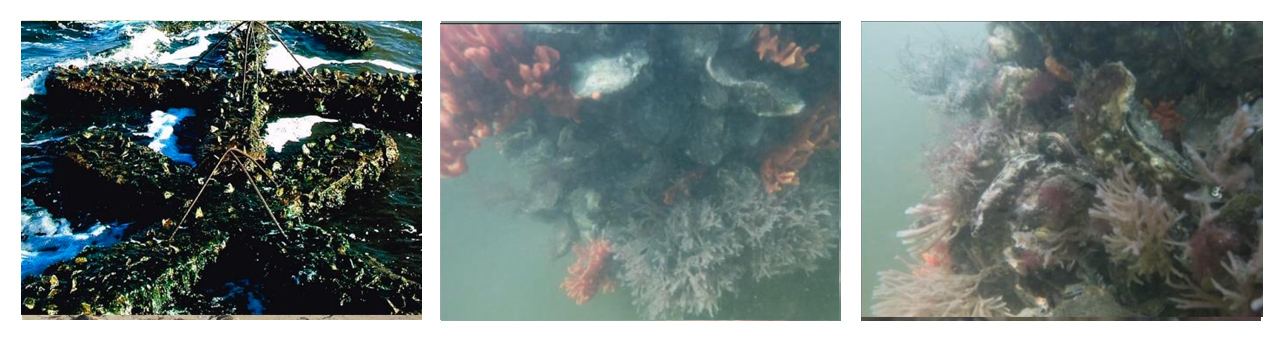
Over time, the original manufactured reef can become the framework for a much larger living oyster reef. Layers of oyster shell can increase the effective size, surface area, and biological complexity of the structure while creating habitat for fish, crabs, and other marine life.
For Tangier Island, X-Reefs are intended to work with restored marsh, dredged sediment, granite sills, and other reef structures to create multiple layers of shoreline protection. As oyster growth expands over the reefs, the system has the potential to become stronger, more biologically productive, and more effective at reducing wave energy over time.
Atlantic Reefmaker
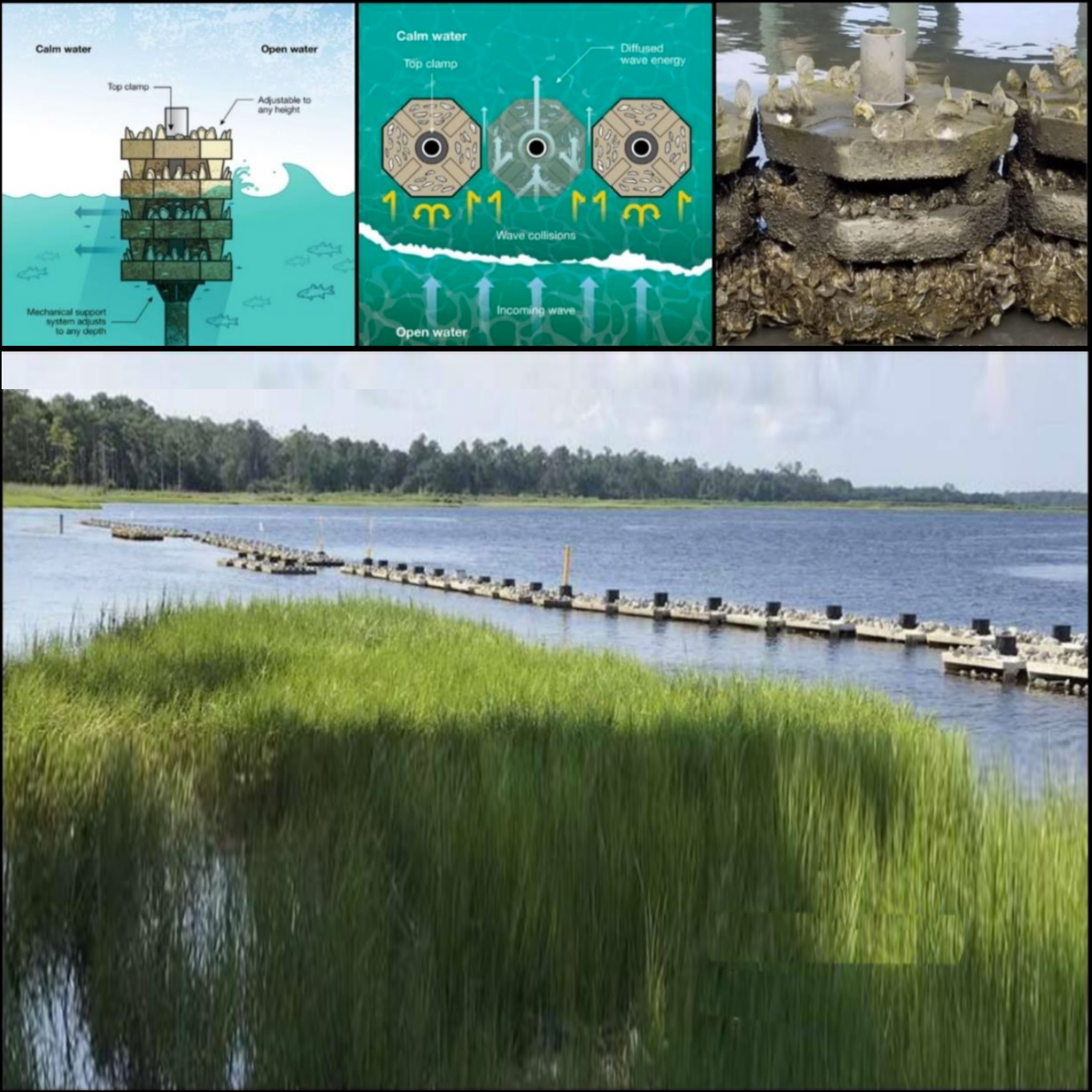
Atlantic Reefmaker (ARM) is a nature-based wave attenuation system that allows water to flow through it while providing wave protection similar to that of a traditional rock breakwater system (TRBS). The system is a pile-based system that consists of concrete disks, referred to as ‘ecodisks’, that can be perched above the substrate by a mechanical support system. Square and octagonal disks have been created and installed.
The legs, or paddles, on the ‘waterfront’ side, or open water/river side of the structure, of the ecodisk direct water to the fiberglass piling. The wave energy through the structure can be controlled by how close or far the paddle is to the pile. When wave energy comes toward the structure with a typical 20% porous ecodisk, the paddles direct water energy to the pile where it becomes concentrated and is forced to travel around the piling. When the water reaches the ‘landward’ side of the structure, the paddles direct the water outward, and water exits the structure. The wave energy dissipates as it travels through the ecodisk because the flow is no longer concentrated. If the waterbody has a high sediment load, then, with a 20% porous structure, sediment in the water column will drop out, accreting in the area between the ARM structures and the shoreline.
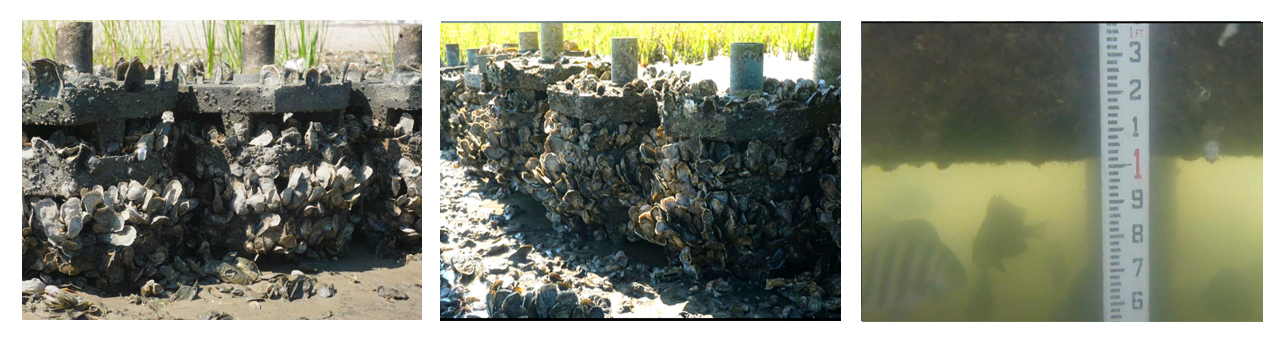
The ARM structure has several advantages over other wave attenuation products and a TRBS. These advantages include:
1) working in horizontally-limited areas;
2) dissipating destructive wave energy;
3) working in high-energy environments;
4) providing habitat for marine fauna, both sessile and motile;
5) having the base unit setting above the substrate, thereby minimizing scour and sand/sediment redistribution;
6) minimizing its ‘footprint’ to the substrate as impacts are limited to the fiberglass pile itself (a 12-inch-diameter fiberglass pile equates to approximately 0.785 ft² of substrate impact per piling);
7) allowing for ‘flushing’ along the entire shoreline and between the open water and shoreline;
8) allowing for modular construction, which enables easy adjustments to accommodate sea-level rise by adding one or more ecodisks to the ARM structure without the need for additional environmental permitting or compensatory mitigation;
9) adjusting the structure location as it can be easily moved and relocated or removed;
10) modifying the porosity of the structure per design criteria, site conditions and/or along the piling;
11) providing the ability to adjust the structure layout to irregular shorelines.
Enhancing Community Resilience to Climate Hazards and Providing Other Co-benefits
ARM has the capability to provide storm surge protection to coastal environments and communities. The structure has been designed to sustain wave energy associated with large transoceanic vessels loaded with containers. The structure has withstood sustained high-tide storm surges associated with tropical storms, particularly Hurricane Florence in 2018, at BTFA without any damage to the structure or required maintenance. At the Bonner Bridge project, the structure has sustained impacts associated with nor’easters and tropical storms, as well as 3-5 feet of inundation associated with Hurricane Dorian in 2019, without any damage to the structure or required maintenance.
The successful wave attenuating capabilities of ARM have been documented via lab studies and field studies. Lab studies were performed by the US Army Engineer Research & Development Center in Vicksburg, MS. The square and octagonal ecodisks were studied in three settings:
1) like a typical TRBS
2) submerged
3) lollipop
Data from these studies will be used to refine project design. The study also modeled the 20% porous structure and a rotated ecodisk to mimic the 0% porous structure. Data from field studies conducted at BTFA used data from stationary buoys to collect the wave energy transmission between the river and shore side of the structure. This study delineated VGW and fetch energy, and collected data for the square ecodisks. For outgoing VGW, the ecodisks, on average, reduced energy by 68%. For all of the fetch events, there was 78% wave energy reduction and, for large storm events, wave energy dissipation averaged 68%.
(Photo Credits: Atlantic Reefmaker, LLC).
Sill Reefs
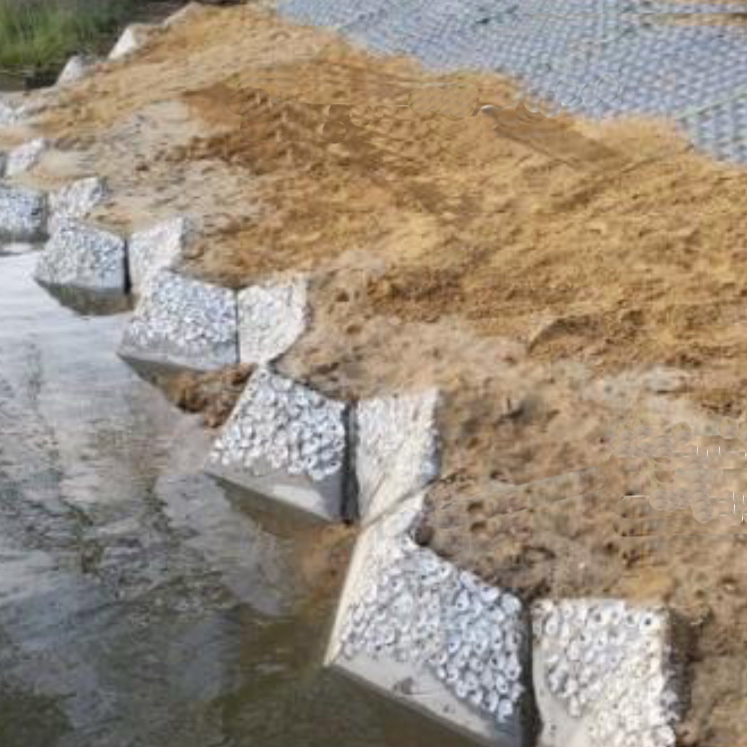
Our Reef Sill living shorelines combine the aesthetics and ecological benefits of an oyster-shell-bag shoreline with the stability of heavier materials and eliminate the use of plastic.
In an oyster-rich environment, we’ve created an oyster reef using the same chemical compound as an oyster shell, and our arrangement provides highly favorable conditions for oyster spat to mature.. Protected from shorebirds and other predators, the Reef Sill interstitial spacing provides the ideal nursery for them to flourish.